Showing posts with label Nichiren Buddhism. Show all posts

Tuesday, 15 March 2011

What is a Buddha?

Posted by Unknown at 8:03 am 0 comments


A Buddha is any being who has become awakened to the ultimate truth of life, one who perceives the true entity of all phenomena, and who leads others to attain the same enlightenment. In India the word buddha was originally a common noun meaning "awakened one," but in Buddhism it is used to mean one who has become awakened to the ultimate truth of life. In Hinayana the word means one who has entered the state of nirvana, in which both body and mind are extinguished. Provisional Mahayana generally teaches that one becomes a Buddha after eradicating illusions through aeons of austere and meritorious practices, gradually acquiring the thirty-two features of a Buddha. 

The perfect teaching of the Lotus Sutra views the Buddha as one endowed with the three virtues of sovereign, teacher and parent, who is enlightened to the truth of all phenomena and who teaches it to the people in order to save them from suffering. In Nichiren Daishonin's Buddhism, the Buddha of the Latter Day of the Law is the original Buddha eternally endowed with the three properties and the three virtues, who appears in the form of a common mortal and expounds the Mystic Law.

SGI Buddhism

Cause & Effect

Posted by Unknown at 7:51 am 0 comments
As we go about our daily lives, in every single moment, we make causes in the things that we think and say and do. Buddhism teaches the existence of a law of cause and effect which explains that when we make a cause, the anticipated effect of that cause is stored deep in our lives, and when the right circumstances appear then we experience the effect.

This concept of cause and effect is at the heart of Buddhism, and the characters for 'renge' in Nam-myoho-renge-kyo mean the simultaneity of the internal cause and the internal effect. This means that, through chanting, we have made the cause for our Buddhahood, and the effect of it exists simultaneously with that cause. By chanting we are directly causing our Buddhahood to appear.

Renge literally means 'lotus flower', which is a beautiful plant that floats on the surface of water and its beauty is nourished through its roots in the mud. This is a metaphor for our lives. Chanting Nam-myoho-renge-kyo uses the `mud` in our lives to enable us to reveal our highest life state.But the Lotus flower is significant for a second reason. It is a plant that flowers and seeds at the same time. It beautifully illustrates the profound working of life where the effect is simultaneous with the cause.


An example of the way Buddhism views cause and effect might be of a young person going home to spend a weekend with their parents. They have a blazing row before the end of the weekend and the young person leaves. In Western society we tend to see the blazing row as the cause and the young person leaving the effect. But Buddhism focuses attention on the internal cause and effect. So it may be that the internal cause turns out to be that the young person disrespects their parents,at quite a deep level, perhaps without realising it. The effect which is simultaneous with this cause is the state of hell, and it is this that is triggering the arguing. This example could equally be the other way round,with the parents doing the disrespecting. It is the internal cause and effect which a person who chants Nam-myoho-renge-kyo can change,replacing their internal feelings with respect.


Through the simultaneity of cause and effect we can cause our Buddhahood to appear. To help us gain a clearer understanding of what Nam-myoho-renge-kyo is we need to appreciate the nine consciousnesses. The nine consciousnesses can be thought of as different layers of consciousness which are constantly operating together to create our lives.And as we progress through explanations of these consciousnesses the significance of the principle of the simultaneity of cause and effect should become apparent.

(SGI-UK Study)

On Karma and Buddha Nature

Posted by Unknown at 5:51 am 0 comments


By Jeanny Chen

(This is a presentation delivered at the first SGIPy National WD and YWD Conference in October, 2002. My trip to Paraguay was approved and permitted by Sensei and the SGI-Japan Headquarters. During my six-day stay I dialogued with the SGIPy members, and had the most incredible experience in my 13 years of practice.)

How many of you know what Buddha nature is?

In order to help you understand this commonly-used term, instead of explaining the term itself, I am going to use an example to demonstrate the characteristics of Buddha nature. Hopefully, the illustration will paint a vivid picture that will allow you to grasp the concept and identify your own Buddha nature. When we understand what Buddha nature is and recognize that we have it within our lives, we can then employ it to work wonders for us. But before I elaborate on the characteristics of Buddha nature, I would like to talk about karma first. 

Understanding karma will help us understand Buddha nature. Karma Every person we encounter, everything that happens to us and the various conditions that surround our lives are the exact manifestations of our karma. Our parents, relatives, friends, co-workers, fellow SGI members, neighbors, exboyfriends… etc. all play different roles in our lives or our karma. Where we were born, where we live, where we work and what incidents occurred at certain points in time are also the manifestation of our karma. Put it this way: our entire life story describes exactly what our karma is. Let me read what Nichiren Daishonin quotes from the Parinirvana Sutra in his writing “Letter From Sado”: "Good man, because people committed countless offenses and accumulated much evil karma in the past, they must expect to suffer retribution for everything they have done. They may be despised, cursed with an ugly appearance, be poorly clad and poorly fed, seek wealth in vain, be born to an impoverished and lowly family or one with erroneous views, or be persecuted by their sovereign. It is due to the blessings obtained by protecting the Law that they can diminish in this lifetime their suffering and retribution." -- The Writings of Nichiren Daishonin, p. 304 

According to this writing, our bad karma was created by what we thought, said and did in the past. Thus, based on the law of simultaneity of cause and effect, we wrote the script of the drama of our own karma. And we will carry it with us lifetime after lifetime, unless we change it through our practice of the Mystic Law. The same writing makes it clear that we have done similar things to people in previous lives, so all the effects are coming back to us in this life. For example, people who are now being physically abused by their spouses must have been the abusers of their spouses or of other people in their previous lives. People who win the lottery this life must have rendered monetary contributions to others in their previous lives.

The Daishonin also says that the most serious cause that we have committed was our past slander of the Mystic Law. On the surface, we suffer because we were born in a poor country or family, born incapable or born physically handicapped… We live on one adversity after another. We can’t find our ideal soul mate. Our children bring us headaches and trouble. Most women never feel pretty enough or sexy enough…etc. Gentlemen don’t express much of their feelings. I don’t know if they are also troubled by such superficial matters as the color, the curve, the length and the thickness of their hair.

Anyways, there are simply hundreds of things that could make our lives so difficult! The true aspect of all those superficial phenomena, however, is that they are our very own karma. We need those people and that environment to play their respective roles in the drama of our lives in order to bring our karma into view. If our karma had not been played out, we would have been unable to change it. Even if we could switch the entire cast, the new players would still act according to what we wrote in the script of our karma.

Our lives would still be the same. For example, let’s say I have bad karma in marriage. I am married to Jose, who loves to flirt and fool around with other ladies. I am very upset about his conduct. Now, forget about Jose. Let another man Humberto be my husband. He would still behave exactly the same. Both of them have no other choice. Anyone who plays the role as my husband has to act according to the script I wrote for my own life. The script of my life says that I will marry a man who flirts with other ladies, no matter how charming I am. I am the director who directs my husband to behave that way. Let’s look at another example. Suppose I was born to a very poor family with 10 siblings. My parents were uneducated. They could barely make a living throughout their lives. Under such circumstances, they failed to provide a good shelter for their children. They were too busy and too worried to even show their love towards the children. This is how my childhood karma says I will live my childhood. I can only be born to this kind of couple, so that I will live my childhood in poverty and without love. Even if another couple became my parents, they would provide me with the same bad living conditions.

Likewise, if we have only good karma in our lives, the drama of our karma would need a cast that manages their lives nicely in order to provide us with happy and comfortable environments and lives. Of course, the people in our lives have their own karma. Only those whose karma is being poor can play the roles of the poor couple, as in our previous example. But they are not to blame for our lives and our destiny. We don’t even have to forgive them. We are totally responsible for whatever we have to go through. Because we accept responsibility for our own lives, we can freely turn it around without depending on other people’s changes or other people’s actions. And we don’t have to carry bitter feelings of being ill-fated, mistreated, and born lowly and trapped, because we asked for it in the first place, and now we can change our destiny by ourselves through practicing Nichiren Buddhism.

The second president of the SGI, Josei Toda, explains that we were all present at the Ceremony of the Air when Shakyamuni Buddha entrusted us, the Bodhisattvas of the Earth, with spreading the Lotus Sutra in the Latter Day of the Law. We were already Bodhisattvas at the time. We should be able to be born into good environments to enjoy happy lives. But, out of our compassion for all human beings, we voluntarily relinquished the reward due us and took that mission. We thus deliberately made bad causes and carried with us the bad karma to be born in the saha world, into an environment with the conditions that we chose of our own volition. Therefore, we were born with our respective karmas to suffer. That suffering becomes the impetus for us to seek out the solution. Under such circumstances, we were willing to embrace our suffering and practice the Mystic Law.

Thanks to Nichiren Daishonin, President Ikeda and the SGI organization, we have the Gohonzon and can follow the correct teaching. Through our diligent practice day in and day out, we polish our lives, activate our wisdom and strong life force from our innate Buddhahood. As a result, we can overcome our difficulties, change our karma, show actual proof, build credibility and deepen our faith. Thus, we become capable of proving the greatness of the Mystic Law and spreading it. Now it is clear why we say that our suffering is our mission. It is the noble mission we took on. It is also the purpose and meaning of our lives. In other words, we use our lives to suffer.

The ultimate purpose of our suffering is to spread the Mystic Law and bring happiness to others. How admirable! In this case, we know that suffering is not the major event of our lives. It is only the prerequisite of our noble mission. Once we realize the true reason behind our suffering, we are done with the suffering part. Then, we can claim to our Gohonzon and our own lives that from now on, we don’t have to suffer any more. We can move on to our main mission, spreading Nichiren Buddhism. With such a realization, we have mentally set ourselves free from our karma. Is my explanation about karma clear enough? Are you still being hypnotized by the words ‘true aspect’, ‘phenomena’ and ‘drama of our karma’? No? Great! So, if our husbands are not successful in their careers and don’t bring enough money home, from now on, are we going to blame them, complain to them, fight with them, bother them to death and leave no peace at home? Of course not! Instead, we should embrace the situation as our karma and take total responsibility. This way, with peace of mind we can focus on changing our karma. Then, we can discuss with our husbands their ideal career goals and chant for the goals as our own. If both partners practice this Buddhism, when the husband joins forces with the wife to chant and take action for those goals, the results will come faster and greater. However, since most husbands are the main income resource for the household, they are tied up with their current jobs. It is up to the wives to decide how much extra effort that they want to devote towards changing their family’s financial karma.

A married couple shares each other’s karma, good and bad. From now on you are the master of your karma instead of its slave. Congratulations! Your status has changed. Now, let’s get back to: Buddha Nature Nichiren Buddhism teaches that we all have Buddha nature inherent in our lives. Even if we cannot perceive it, at least with our common sense we can tell that it is good stuff. Since it is said that we already have ownership of it, it doesn’t hurt and doesn’t cost us a penny to bring some value out of it, right? We should at least give ourselves a chance to try it out. I have found out that Buddhahood is an incredible channel for us to use to communicate with another person without the person’s presence, contacting them through our minds when we chant Nam-myoho-renge-kyo. Many people encounter problems communicating with their loved ones, their associates at work or their fellow SGI members… etc. If we have found no other opportunity or possibility to smooth out our relationships with others, this is the ultimate way out! How do we communicate with another person’s Buddhahood?

Why open up Buddha nature? How does it work? Just like some people have active, positive and aggressive natures, and other people’s natures are negative, domineering, and abusive, Buddhas have their nature too. Among the characteristics of Buddha nature are wisdom, life force, compassion and happiness. 

Buddha’s immense wisdom sees the true aspect of all phenomena. People whose life state is in Buddhahood understand how karma functions in their lives. They are not deceived by the superficiality of any situation. In other words, they know that any situation happens to them because they themselves have made their karma that way. Their karma is the ‘real aspect’ or the ‘underlying truth’ of their suffering. With that wisdom, they know that they should work on changing their karma instead of focusing on suffering from the terrible things that happen to them. They certainly are wise enough to know how to communicate based on the truth, nothing but underlying truth. They know how to manage damage control, how to interact perfectly, and what to say to reach the win/win result. 

When people emerge their Buddha nature, their strong life force won’t be defeated by any circumstance. Again, because they understand karma, no matter how bad the situation, they have no worries and no negative concerns. Their wisdom gives them a clear mind about the truth of all problems they encounter. Also, they know how to eradicate their karma. Thus, they are strong, upbeat and courageous. When two such positive minds talk, their optimistic energy can only spark a constructive outcome. Compassion is the lifeblood and trademark of Buddhas. They respect and embrace all beings as they are and for what they are, regardless of their status. Thus, both ways of any communication are original, genuine and straightforward without being distorted, abated or blocked. Messages will be sent compassionately and humbly at one end. They will be warmly acknowledged, equally treated and thoughtfully responded to by the other person. How can anything not turn out to be harmonious and satisfactory this way?

With the wisdom to see the underlying truth of all phenomena, with the undefeatable life force to overcome any challenge and with the compassion to create nothing but good causes, Buddhas enjoy absolute happiness under all circumstances. They take everything as a blessing because they can always change poison into medicine. Nothing could ever upset or irritate them in such a high life condition. In other words, whatever you say is perfectly fine. Thus, is it a surprise that the dialogue between two forever-happy people comes to a happy ending? Prayers offered from the bottom of our hearts in the world of Buddha reach every corner, move the most obstinate and work wonders, be it a relationship, health, job hunting or promotion issue. It is the ultimate dialogue we conduct with Gohonzon, the universe, ourselves, family members, friends, co-workers, future employers, future soul mate, ex-husband, ex-girlfriend… etc. 

A heartbroken elderly mother had been mistreated by her son and daughter-in-law. She was devastated. She depended on their assistance in areas of her daily life. What she asked from them – especially from her son – was fair and clear communication. She was unable to get it. Her son only listened to his wife’s twisted, one-sided stories, putting her on the spot. After learning about dialogue in the world of Buddha, she engaged in a sincere daimoku campaign. She put all three of them in the world of Buddha. She apologized for the inconvenience she had placed on them. She appreciated their filial caring and prayed for the daughterin-law’s happiness. She specifically chanted for her son’s wisdom to see the truth. Within a week, her son’s attitude changed totally. Within one month, the daughterin-law became sweet and thoughtful. The elderly woman was overjoyed; she had found her happiness again. Throughout the episode, no outsider had to risk becoming entangled in their domestic affairs. Not a single person became offended. It was a seamless victory, achieved through heart-to-heart dialogue, via daimoku, at the state of Buddhahood.

Now, let’s check to see if we have the above mentioned characteristics of a Buddha within our lives. In “The Opening of the Eyes” (WND p 279) Nichiren Daishonin refers to what the Contemplation on the Mind Ground Sutra says: “If you want to understand the causes that existed in the past, look at the results as they are manifested in the present. And if you want to understand what results will be manifested in the future, look at the causes that exist in the present.” This quote urges us to be wise in what we do now in order to live our ideal life in the future. It is based on this same teaching that Buddha wisdom can perceive past, present and future. Now that we understand karma, we already have the same wisdom to see the three existences of our lives too! In my humble opinion, as practitioners of Nichiren Buddhism, once we understand the true aspect of karma, we have the wisdom and compassion to embrace all occurrences and all people that appear in our environment. We don’t need to place blame on other people anymore. Because we now know how to turn around our situation through this Buddhism, we are motivated to muster a strong life force with which to face our difficulties head on. 


Our wisdom is powerful only when accompanied by the correct action. Well, we understand karma. But how do we eradicate karma so that we can move on to a brand new life? We may work through two channels: through our Buddhist practice and through working in the real world. Let’s talk about eradicating karma through Buddhist practice:

1. We set goals of how we wish to change our karma and chant for the goals. If we suffer from financial karma, we set a goal to become rich! If we suffer from the karma of illness, we set a goal to become as strong as a bull! And if our relationship is a pain in the neck, we set a goal to become women of irresistible charisma, wisdom and virtue who could enjoy their sweetheart’s love more and more each day!

2. But besides chanting for the goal, we have to take action to make the goal come true. I set the goal for my husband to love me more and more each day over ten years ago. Since then he has been working very hard and non-stop to keep my goal a reality. It is the smartest goal I have ever set for my life. But, I don’t just chant and do nothing. I work hard to make myself deserve his infinite love.

3. We introduce this Buddhism to as many people as possible, to fulfill our mission. This way, we are showing that we have moved to our true mission and that we are too busy to suffer any more. Shakubuku is one of the most effective ways to eradicate karma and to bring us fortune.

4. We chant to eradicate our karma. Chanting Nam-myoho-renge-kyo puts us on the right track and in perfect rhythm with the universe. According to what the Daishonin writes in “On Prolonging One’s Life Span”: “Sincere repentance will eradiate even fixed karma, to say nothing of karma that is unfixed.” (WND p 954) I would like to use the person in the previous example, whose parents are very poor and has 10 siblings, as an example to illustrate how we can pray to eradicate karma:

1. I apologize to Gohonzon for my past slander of the Mystic Law, and now I am going to help spread and protect the Mystic Law.

2. I apologize to Gohonzon for the bad causes I have created in the past. I vow to Gohonzon that because now I practice this Buddhism, I will create only good causes, and no more bad causes.

3. I apologize to my parents that because of my bad karma, they had to suffer their lives in poverty and anxiety in order for me to experience my bad karma.

4. I appreciate my parents because they used their lives to suffer in order to manifest my bad karma. Otherwise, I wouldn’t be able to eradicate it. I also appreciate their tremendous hard work in raising my 10 siblings and praise all the good virtues they have.

5. I promise to Gohonzon and myself that I am going to practice this Buddhism very earnestly so that I can eradicate my bad karma. In this case, my parents and I will not have to suffer from poverty anymore.

6. I reassure Gohonzon that now that I am awakened to my true identity as a Bodhisattva of the Earth, I will definitely carry out my true mission to help others without having to use my own suffering as an impetus. In this case, I don’t have to suffer anymore. Now, let’s talk about eradicating karma through working in the real world: What we think, say and do becomes the substance of our life. If we keep on doing the same thing as before, our lives will be forever the same. In fact, our lives will get worse as we grow older. Therefore, if we want to live a different life, we have to do things differently, or do something extra. I personally really dislike suffering, therefore, if I have to choose, I will do both to change my life once and for all! When we chant for the goal to change our job karma, we mean to advance and increase our income. The Buddhist Gods will protect us and provide right opportunity. Our wisdom will emerge and we get better ideas with fulfill this goal. Our life force will be strong so that we can endure to breakthrough. in our job us with the which to the process.


Here comes the hard part. We are already tied up with everyday work. In order to do something extra, we might have to sacrifice our sleep and leisure time. Please don’t dislike me because I say this. Every move creates new causes in our lives. A good cause produces good effects; a bad cause, bad effects; no cause, no effects. Therefore, we have to be very diligent, active, earnest, positive and hard working. There’s no time to worry, to complain or to feel sad. For example, if we want to get out of poverty, we need to increase our skill in making money. We obtain more education or learn from all kinds of resources. We can work on more than one job. We spend more time on and work harder at our job to become more skillful and to get promotions. We also try to stop unnecessary spending. Of course we can set a goal to marry a millionaire. Then we will instantly become rich without going through all the effort! But the opportunity is limited to the single persons and maybe only for the pretty or handsome ones. Unless we have the penetrating ichinen to work persistently and make a change, we will soon go back to our routine before we see any change.

We have to plunge into an all-out effort to totally turn around our life. We should not give up and just run away from the problem. Otherwise, 10 years or 20 years from now, we will still be suffering from the same thing and living the same old sorrowful life. It might take five to ten years before we see the solid result. But, if we don’t ever do it, it will never happen, even after lifetimes. Our karma will stay with us forever. We get to make the decision. Do you feel restless and breathless after hearing all the heavy-duty words? Since I came a long way, this is a rare opportunity for me. I have to show off my ‘strength’. You may wonder where the way out is. As the practitioners of Nichiren Buddhism, we have Gohonzon and infinite fortune. We know how to set goals and to chant for them. We have the protection, wisdom and life force to fight against vicious karma. Although the job market is so bad, there are still hundreds of thousands of jobs that need to be filled. Our determination is that as long as there is still one opportunity available, we should be the one who gets the job. That’s the best opportunity for us to show our strength as Buddhists. Yes, the economy is so bad. But there are plenty of people who are still doing very well financially. We should determine to be among those people who are successful and can show actual proof. This is the best opportunity for us to exert ourselves to prove the validity of this great Buddhism! The lives of the practitioners of Nichiren Buddhism withstand any hardship because the benefits of Gohonzon are expansive, infinite and know no bounds! Buddhism is to win or to lose.

This Buddhist practice is powerful but not magic. It can help manifest amazing results only when accompanied by our strong determination and untiring actions. There’s absolutely no shortcut. We have to take persistent and painstaking actions to make things happen. Even though there is the law of simultaneity of cause and effect, we cannot expect good effect to fall on us prior to making good cause. Cause must precede effect. If we are not happy with our country’s karma, the change starts from our personal karma. Each and every one of us can contribute to make a difference!

The Ten Worlds

Posted by Unknown at 5:34 am 0 comments
One way that Buddhism explains life is through a concept known as "the ten worlds." These are ten states or conditions of life that we experience within ourselves and are then manifested throughout all aspects of our lives. Each of us possesses the potential for all ten, and we shift from one to another at any moment, according to our interaction with the environment. That is, at each moment, one of the ten worlds is being manifested and the other nine are dormant. From lowest to highest, they are:

Hell -- This is a state of suffering and despair, in which we perceive we have no freedom of action. It is characterized by the impulse to destroy ourselves and everything around us.

Hunger -- Hunger is the state of being controlled by insatiable desire for money, power, status, or whatever. While desires are inherent in any of the ten worlds, in this state we are at the mercy of our cravings and cannot control them.

Animality -- In this state, we are ruled by instinct. We exhibit neither reason nor moral sense nor the ability to make long-range judgments. In the world of Animality, we operate by the law of the jungle, so to speak. We will not hesitate to take advantage of those weaker than ourselves and fawn on those who are stronger.

Anger -- In this next state, awareness of ego emerges, but it is a selfish, greedy, distorted ego, determined to best others at all costs and seeing everything as a potential threat to itself. In this state we value only ourselves and tend to hold others in contempt. We are strongly attached to the idea of our own superiority and cannot bear to admit that anyone exceeds us in anything.


Humanity (also called Tranquillity) -- This is a flat, passive state of life, from which we can easily shift into the lower four worlds. While we may generally behave in a humane fashion in this state, we are highly vulnerable to strong external influences.

Heaven (or Rapture) -- This is a state of intense joy stemming, for example, from the fulfillment of some desire, a sense of physical well-being, or inner contentment. Though intense, the joy experienced in this state is short-lived and also vulnerable to external influences.

The six states from Hell to Heaven are called the six paths or six lower worlds. They have in common the fact that their emergence or disappearance is governed by external circumstances. Take the example of a man obsessed by the desire to find someone to love him (Hunger). When he at last does meet that person, he feels ecstatic and fulfilled (Heaven). By and by, potential rivals appear on the scene, and he is seized by jealousy (Anger). Eventually, his possessiveness drives his loved one away. Crushed by despair (Hell), he feels life is no longer worth living. In this way, many of us spend time shuttling back and forth among the six paths without ever realizing we are being controlled by our reactions to the environment. Any happiness or satisfaction to be gained in these states depends totally upon circumstances and is therefore transient and subject to change.

In these six lower worlds, we base our entire happiness, indeed our whole identity, on externals.

The next two states, Learning and Realization, come about when we recognize that everything experienced in the six paths is impermanent, and we begin to seek some lasting truth. These two states plus the next two, Bodhisattva and Buddhahood, are together called the four noble worlds. Unlike the six paths, which are passive reactions to the environment, these four higher states are achieved through deliberate effort.

Learning -- In this state, we seek the truth through the teachings or experience of others.

Realization -- This state is similar to Learning, except that we seek the truth not through others' teachings but through our own direct perception of the world.

Learning and Realization are together called the "two vehicles." Having realized the impermanence of things, people in these states have won a measure of independence and are no longer prisoner to their own reactions as in the six paths. However, they often tend to be contemptuous of people in the six paths who have not yet reached this understanding. In addition, their search for truth is primarily self-oriented, so there is a great potential for egotism in these two states; and they may become satisfied with their progress without discovering the highest potential of human life in the ninth and tenth worlds.

Bodhisattva -- Bodhisattvas are those who aspire to achieve enlightenment and at the same time are equally determined to enable all other beings to do the same. Conscious of the bonds that link us to all others, in this state we realize that any happiness we alone enjoy is incomplete, and we devote ourselves to alleviating others' suffering. Those in this state find their greatest satisfaction in altruistic behavior.


The states from Hell to Bodhisattva are collectively termed "the nine worlds." This expression is often used in contrast to the tenth world, the enlightened state of Buddhahood.

Buddhahood -- Buddhahood is a dynamic state that is difficult to describe. We can partially describe it as a state of perfect freedom, in which we are enlightened to the ultimate truth of life. It is characterized by infinite compassion and boundless wisdom. In this state, we can resolve harmoniously what appear from the standpoint of the nine worlds to be insoluble contradictions. A Buddhist sutra describes the attributes of the Buddha's life as a true self, perfect freedom from karmic bonds throughout eternity, a life purified of illusion, and absolute happiness. Also, the state of Buddhahood is physically expressed in the Bodhisattva Way or actions of a Bodhisattva.


The Mutual Possession of the Ten Worlds
The ten worlds were originally thought of as distinct physical realms into which beings were born as a result of accumulated karma. For example, human beings were born in the world of Humanity, animals in the world of Animality and gods in the world of Heaven. In Nichiren Daishonin's Buddhism, the ten worlds are instead viewed as conditions of life that all people have the potential to experience. At any moment, one of the ten will be manifest and the other nine dormant, but there is always the potential for change.

This principle is further expressed as the mutual possession of the ten worlds -- the concept that each of the ten worlds possesses all ten within itself. For example, a person now in the state of Hell may, at the next moment, either remain in Hell or manifest any of the other nine states. The vital implication of this principle is that all people, in whatever state of life, have the ever-present potential to manifest Buddhahood. And equally important is that Buddhahood is found within the reality of our lives in the other nine worlds, not somewhere separate.
In the course of a day, we experience different states from moment to moment in response to our interaction with the environment. The sight of another's suffering may call forth the compassionate world of Bodhisattva, and the loss of a loved one will plunge us into Hell. However, all of us have one or more worlds around which our life-activities usually center and to which we tend to revert when external stimuli subside. This is one's basic life-tendency, and it has been established by each individual through prior actions. Some people's lives revolve around the three evil paths, some move back and forth among the six lower worlds, and some are primarily motivated by the desire to seek the truth that characterizes the two vehicles. The purpose of Buddhist practice is to elevate the basic life-tendency and eventually establish Buddhahood as one's fundamental state.

Establishing Buddhahood as our basic life-tendency does not mean we rid ourselves of the other nine worlds. All these states are integral and necessary aspects of life. Without experiencing the sufferings of Hell ourselves, we could never feel true compassion for others. Without the instinctive desires represented by Hunger and Animality, we would forget to eat, sleep and reproduce ourselves, and soon become extinct. Even if we establish Buddhahood as our fundamental life-tendency, we will still continue to experience the joys and sorrows of the nine worlds. However, they will not control us, and we will not define ourselves in terms of them. Based on the life-tendency of Buddhahood, our nine worlds will be harmonized and function to benefit both ourselves and those around us.

The Altar

Posted by Unknown at 5:17 am 0 comments
The ButsudanThe butsudan (Japanese: Buddha House) is the cabinet where you enshrine your Gohonzon to protect it. The butsudan or cabinet is usually made of wood. It can range from a simple, plain design to elaborate finishes and hardware. Every believer should endeavor to keep the butsudan dusted and clean and make it an attractive place for the Gohonzon.

Evergreens
Evergreens symbolize the "property-of-action", the Buddha's enlightened physical property or his compassionate action and the potential to form a correct relationship with the environment that allows us to manifest our Buddha nature. The evergreens are used to adorn the space before the Gohonzon, which is eternal and supreme. Therefore, they should be something symbolic of permanence and purity.

Water
A cup of fresh water is placed before the Gohonzon each day prior to morning gongyo, it is removed just before evening gongyo. Traditionally water was offered as something of great value in the hot country of India where Buddhism began. It also has the property to purify. After being offered, the water may be put into another cup and then consumed.

Food
Fruit or other non-animal foods can be another offering to the Gohonzon. The food may be consumed after it has been offered to the Gohonzon. Cooked food, such as rice, is sometimes offered on special occasions, such as New Year's Day. When offering food, we ring the bell three times, place our palms together and chant Nam-myoho-renge-kyo three times as a gesture of deep gratitude and appreciation.

Candles
Candles stand for the truth of non-substantiality or the latent potential of life. They also represent the property of wisdom or the Buddha's enlightened spiritual property and they symbolize the potential wisdom to become aware of our innate Buddha nature. Since it extinguishes darkness and makes all things visible, light expresses the Buddha's property of wisdom and his wisdom itself so we also have expressions like "Light of the Law," "Light of the Buddha," and "Light of Wisdom." Burning candles thus also signifies incinerating earthly desires and the sparking of the flame of wisdom in the Buddha nature. Symbolically, the light (candle) signifies the light of the Buddha's wisdom.

Parents of small children may prefer to use battery operated candles or avoid lighting candles.

Incense
Incense represents the truth of the Middle Way, the essential property of the Buddha's life or the property of the Law, and the potential of our innate Buddha nature. One to three sticks of incense are burned in a flat position so as to help engender a feeling of serenity before the Gohonzon. The incense burner is placed in the center of the altar, and incense is burned from left to right. Incense serves to create a fragrant atmosphere and is burned in front of the Gohonzon during morning and evening gongyo. The Great Teacher T'ien T'ai wrote, "No color, nor fragrance is not of the Middle Way." This indicates that all things encompass the True Aspect of the Middle Way, as well as elucidates that the fragrance of incense includes the virtues of the Buddha of the Law Body of the Middle Way. Thus burning incense, while spreading fragrance throughout the room, also signifies, through the fragrance's spreading throughout the environs, the universality of the realm of the Law of the Buddha's property of the Law. although stick incense is used most of the time, powdered incence is used under certain circumstances, such as funeral and memorial services.

Parents of small children or those with allergies may prefer not to use incense.

Bell
The ringing of the bell during gongyo serves to offer a pleasing sound to the Gohonzon and life. It should therefore not be sounded jarringly, but in a way that is pleasing to the ear. There is a specific pattern of bell ringing in the course of the morning and evening recitation of the sutra (gongyo). It is described in the sutra book, The Liturgy of the Buddhism of Nichiren Daishonin. If you live in an apartment complex or with others, be careful not to ring the bell so loudly that it might disturb them.

Prayer Beads


The prayer beads are a traditional accessory. The basic number of beads is 108, which is said to represent the number of earthly desires which common mortals have.
When we use beads during Gongyo, the end of the figure eight, with the two strands, is place over the third finger of the left hand. The end with the three strands, over the third finger of the right. They lie on the outside of the hands, which are placed together with palms and fingers touching each other.
Although traditional meaning has been assigned to the various parts of the prayer beads, they have no special power and are not an essential part of the Buddhist practice.

Sutra Book

Practice for ourselves is to chant Nam-myoho-renge-kyo each morning and evening along with reciting Gongyo (two chapters of the Lotus Sutra).

Study Material
Nichiren Daishonin taught that study is an important part of the practice. In the "True Entity of Life" he wrote, "Believe in the Gohonzon, the supreme object of worship in the world.... Exert yourself in the two ways of practice and study. Without practice and study, there can be no Buddhism. You must not only persevere yourself; you must also teach others. Both practice and study arise from faith. Teach others to the best of your ability, even if only a single sentence or phrase. Nam-myoho-renge-kyo, Nam-myoho-renge-kyo." MW Vol. I, pg 89.

There are three fundamentals in the practice of Nichiren Daishonin's Buddhism. Faith, Practice and Study. Faith means to believe in the Gohonzon of the Three Great Secret Laws, when you first begin this is just hope that it will help your life. Practice means to chant Nam-myoho-renge-kyo yourself and to teach others. Study means to study and understand the Buddhist teachings. Among these three, faith is the most fundamental for the attainment of Buddhahood. Faith gives rise to practice and study, and practice and study serve to deepen one's faith.

Source: SGI-USA

The Practice of Buddhism

Posted by Unknown at 4:45 am 0 comments
From the sgibuddhism.org site

Each of us possesses the potential for a winning life. Within us is the ability to live with courage, to have fulfilling relationships, to enjoy good health and prosperity, to feel and show true compassion for others, and the power to face and surmount our deepest problems.Crucial to living a winning life is to undergo an inner transformation that will enable us to bring out our highest human qualities and change our circumstances. This process is a revolution of our own character, an individual human revolution.

Consider the following scenario:

Perhaps you feel under-appreciated at work. Maybe your boss is belligerent or ignores you. After a while you develop a chip on your shoulder. Though you may be an expert at hiding negativity, every once in a while it rears its ugly head. Perhaps your co-workers or boss perceive you in turn as not being entirely committed to the success of your job, or that you have a bad attitude. Of course there are myriad reasons for your attitude and all of them "valid." But whatever the reasons, you miss opportunities for advancement because of the poor relationship. This is a common scenario in today's working environment.But suppose you start coming to work with a new attitude that is not just a mental adjustment but an outlook bolstered by a deep sense of vitality, confidence and compassion, and based upon serious self-reflection. Your compassion leads you to have empathy for your boss's situation. Armed with a new understanding, you treat your boss differently, offering support and finding yourself less and less discouraged by any negativity he or she may display toward you.

Your boss begins to see you in a new light. Opportunities present themselves.This is obviously a very simple example and many of us would say this is a natural thing to do, but to live this way every day requires a basic change in our hearts and character. Once the change is made, like a never-ending domino effect, we can have continual impact on the people around us.
The practice of Buddhism as taught by Nichiren Daishonin is a catalyst for experiencing this inner revolution. It provides us with immediate access to the unlimited potential inherent in our lives by which we can live a winning life.
It is the promise of Nichiren Daishonin's Buddhism that we can attain a state of freedom and unshakable happiness for ourselves while creating harmony with others.
Buddhism is a way of life that — on the most fundamental level — makes no distinction between the individual human being and the environment in which that person lives. Like a fish in water, the two are not only inseparable, but each serves as a catalyst for the other. Thus, to a Buddhist, self-improvement and enhancement of our circumstances go hand in hand. The two are actually so interlocked that it is incorrect to consider them separate entities. In treating the sufferings and delusions of human beings, there is the accompanying benefit of better social conditions, since the one is the source of the other Ö for better or worse.

While the word Buddha may conjure up images of a specific person from history or world religions courses we have taken, it is also a description of the highest state of life each of us can achieve. Buddha actually means "awakened one," and the historical Buddha (known as Shakyamuni or Siddhartha Gautama) discovered that all humans have a potential for enlightenment - or "Buddhahood" in the depths of their lives. This could be likened to a rosebush in winter; the flowers are dormant even though we know that the bush contains the potential to bloom. Similarly, by tapping into our potential, we can find unlimited wisdom, courage, hope, confidence, compassion, vitality and endurance. Instead of avoiding or fearing our problems, we learn to confront them with joyful vigor, confident in our ability to surmount whatever life throws in our path.

Buddhism also shows us the most satisfying way to live among others. It explains that when we help others overcome their problems, our own lives are expanded. When our capacity increases and our character is strengthened, the source of our problems comes under our control. Because we make an internal change, our relationship with our problems changes as well, wresting positive resolutions in any number of astounding yet tangible ways.Through this process of inner reformation, we can also fulfill our dreams and desires. Rather than calling for the eradication of desires, Nichiren Daishonin's Buddhism recognizes that to be human means to have desires and that as we proceed in our human revolution, we elevate our state of life, "magnetizing" our lives to attract that which will further our happiness.

Not only do we fulfill our desires as we change ourselves through Buddhist practice, but the very pursuit of those desires through our practice is like rocket fuel propelling us toward our enlightenment. Life is ever-changing, moment-to-moment. The only constant in life is change. Our minds are constantly in flux, and while one minute we may have the courage to conquer the world, the next minute we can be overwhelmed by even the simplest occurrences. But through our steady, daily practice, we continually strengthen our resolve and ability to live a winning life. Winning in life, however, is not the absence or avoidance of problems. Being human, almost by definition, means we will constantly meet up with challenges. True happiness or victory in life is having the tools to take on each hurdle, overcome it, and become stronger and wiser in the process. Inside each human being is a storehouse of all the necessary traits to tackle every problem that confronts us. Buddhism is the practice that allows us access to this storehouse and unleashes our inherent power to take on all of life's challenges and win.

Section Two

The Practice

There are three basics in applying Buddhism: faith, practice and study. They are the primary ingredients in the recipe for developing our innate enlightened condition, or Buddhahood. All three are essential. With this recipe, we will experience actual proof of our transformation in the forms of both conspicuous and inconspicuous benefit. The recipe is universal. These basics are the same in every country where this Buddhism is practiced.

Faith --Traditionally, religion has asked its believers to have faith in its tenets before accepting the religion, without any proof of the religion's assertions. But how can we have faith in something with which we have no experience? Unless a religion can provide benefit to the believers' daily lives and help them overcome their struggles, they cannot become happy by practicing it. Today, many religions lack the ability to truly empower people to change.

 In Buddhism, faith is based on experience. Nichiren Daishonin's Buddhism emphasizes obtaining "actual proof" of the teaching's power. Faith begins as an expectation or hope that something will happen. At the start of our journey, if we are willing to try the practice and anticipate some result, we will then develop our faith brick by brick as examples of actual proof accrue.

Practice -- To develop faith, we must take action. We strengthen our wisdom and vital life force by actualizing our Buddhahood each day in a very concrete way. Practice in Nichiren Daishonin's Buddhism consists of two parts: practice for ourselves and practice for others. Practice for ourselves is primarily the chanting of Nam-myoho-renge-kyo. Each morning and evening, believers participate in a ritual that, along with chanting Nam-myoho-renge-kyo, includes recitation from two significant chapters of the Lotus Sutra chapters which explain that each individual holds the potential for enlightenment and that life itself is eternal. This ritual has been traditionally referred to as gongyo (literally, "assiduous practice").
Practice for others consists of action based on compassion to help give others the means to make fundamental improvements in their lives, similar to what we are undergoing through our own engagement with Nichiren Daishonin's teachings. The development of our compassion through such practice for others is also a direct benefit to us.

Study -- To gain confidence that this practice is valid, and to understand why your efforts will bring about a result, it is essential to study the tenets of this Buddhism. The basis of study comes from the founder himself, Nichiren Daishonin. More than 700 years ago, he instructed followers in the correct way to practice; and his writings, which have been preserved and translated into English, give us valuable insight into how this practice will benefit us today.


The Soka Gakkai International (SGI) was formed to support practitioners of Nichiren Daishonin's Buddhism and help them teach others about it on a global scale. Today, there are some 12 million members in 156 countries, and the American branch is called SGI-USA (for more information, please see Section Four).
The SGI has prepared numerous study materials that offer deeper looks at Buddhist theory, as well as practical applications through members' testimonies. There are also English translations of the original teachings of Buddhism, such as the Lotus Sutra. By helping to build understanding and confidence, the study material provides vital encouragement for us especially at crucial moments.


The basic prayer or chant is Nam-myoho-renge-kyo.

This is the name of the Mystic Law that governs life eternally throughout the universe. Nichiren Daishonin revealed this law as the underlying principle contained in Buddhism's highest teaching, the Lotus Sutra. All life is an expression or manifestation of this law. Thus when we chant this Mystic Law, we attune our lives to the perfect rhythm of the universe. The result is increased vital life force, wisdom, compassion and good fortune to face the challenges in front of us.

The translation of Nam-myoho-renge-kyo is as follows:

Nam -- Devotion. By devoting our lives to this law through our faith, practice and study, we will awaken the life-condition of Buddha, or enlightenment, inside ourselves.

Myoho -- Mystic Law. As the Daishonin explained in one of his writings: "What then does myo signify? It is simply the mysterious nature of our life from moment to moment, which the mind cannot comprehend or words express. When we look into our own mind at any moment, we perceive neither color nor form to verify that it exists. Yet we still cannot say it does not exist, for many differing thoughts continually occur. The mind cannot be considered either to exist or not to exist. Life is indeed an elusive reality that transcends both the words and concepts of existence and nonexistence. It is neither existence nor non-existence, yet exhibits the qualities of both. It is the mystic entity of the Middle Way that is the ultimate reality. Myo is the name given to the mystic nature of life, and ho, to its manifestations" (The Writings of Nichiren Daishonin, p. 4; see "Suggested Readings").

Renge -- Literally, the "lotus flower," which seeds and blooms at the same time. This represents the simultaneity of cause and effect. We create causes through thoughts, words and actions. With each cause made, an effect is registered simultaneously in the depths of life, and those effects are manifested when we meet the right environmental circumstances. Life itself is an endless series of causes and simultaneous effects. Chanting Nam-myoho-renge-kyo is the deepest cause we can make in order to produce our desired effect.

Kyo -- Sound or teaching. This is how the Buddha has traditionally instructed Ö through the spoken word, which is heard.

Myoho-renge-kyo is the Lotus Sutra's title and contains its essential meaning. Nichiren Daishonin added namu (contracted to nam), which comes from Sanskrit. Nam-myoho-renge-kyo is the ultimate invocation of life, often referred to as the language of the Buddha.
There are no prerequisites or rules as to what to chant for. We simply make the decision to begin chanting Nam-myoho-renge-kyo. And by chanting, we experience the energy and wisdom to make our lives fulfilled. In the sixty years since this Buddhism has been widely accessible through the efforts of the Soka Gakkai worldwide, millions have chanted about every conceivable problem and goal, from the most dire health and financial crises to the most urgent matters of the heart. Unlike in most Western religions, when we chant we are not praying to an external deity invested with human qualities like judgment. Our prayers are communicated into the depths of our being when we invoke the sound of the Mystic Law. This universal Law is impartial, and no prayer is more or less worthy than another. The only issue is whether we can create value in our lives and help others do the same. As the Daishonin teaches, we attain enlightenment through a continual transformation that takes place in the depths of our existence as we seek to fulfill our desires and resolve our conflicts. It is important to understand that our prayers are realized because we bring forth from within ourselves the highest life-condition and the wisdom to take correct action.

Once people begin experiencing the benefits of chanting, they may decide to make a deeper commitment and begin a more complete Buddhist practice. The first milestone after beginning one's practice is to receive the Gohonzon, the object of devotion for Nichiren Daishonin's Buddhism. The Daishonin inscribed his enlightenment in the form of a mandala called the Gohonzon, and believers chant Nam-myoho-renge-kyo to a scroll form of the Gohonzon enshrined in their own homes. (For information on how to receive the Gohonzon, please ask your sponsor or contact the SGI organization in your area.

In the Gohonzon, the Daishonin graphically depicted his enlightenment, or Buddhahood, which is the enlightened life-condition of the universe. The important point here is that the same potential for enlightenment exists within each of us. And when we fuse our lives with the Gohonzon by chanting Nam-myoho-renge-kyo to it, we tap into that enlightened life-condition, our own Buddhahood.


This is why the Daishonin calls the Gohonzon a mirror for the inner self. It is a way to see inside, to begin changing what we don't like and strengthening what we do like. We have the potential of many life-conditions, which appear when we come in contact with various external stimuli. For instance, someone may be rather mild-mannered and quiet, but another person might say something that sparks a show of temper. This temper or anger was dormant inside until provoked by the environment. To bring out our highest potential condition of life, our Buddhahood, we also need a stimulus. As our conviction develops, we will come to see that the Gohonzon is the most positive external stimulus, and chanting Nam-myoho-renge-kyo to it is the internal cause that will activate the latent state of Buddhahood in our lives.

The scroll of the Gohonzon is kept on an altar in the practitioner's home where it can be protected from the daily routine of the household.

The Roots

Posted by Unknown at 4:37 am 0 comments
Buddhism is one of the world's oldest religions. At its core are the quests to understand life and to help people overcome their basic sufferings. Nichiren Daishonin's Buddhism traces its origins to the teachings of Shakyamuni, who is said to have lived some 2,500 years ago. Known as Siddhartha Gautama in his youth, at age 19, he was a royal heir in India. His palace life was far removed from the everyday life of common people, and when he discovered how people suffered outside the palace walls, he set out to find out how to overcome the roots of basic human suffering.
He made it his life's purpose to find solutions to the inescapable sufferings of life. He sought the foremost teachers of his day and practiced the extreme forms of asceticism they advocated as the means to realize the ultimate reality of life. After following their teachings for several years, and on the point of death from fasting, Shakyamuni realized that their path was too extreme. He awakened to the wisdom of the "middle way," neither the extreme of austerity nor of indulgence.

After accepting food from a young girl, he sat down under the "Bodhi" (a pipal) tree. There he entered a profound meditation and finally attained enlightenment. He began at once to teach anyone who would listen. He would engage admirer and objector alike in dialogue and discourse to convey his awareness and insight into the human condition. Since the depth of Shakyamuni's understanding far surpassed that of even the most learned of his day, he had to prepare his listeners by first teaching them more easily understood doctrines, using parables and everyday analogies in the process. In this way, he could elevate the life-condition of those he taught, while always holding to his ultimate aim of showing people that they inherently possessed Buddhahood and could develop the qualities needed to conquer their sufferings.

For some forty years following his awakening at age 30, he imparted to others portions of his own enlightenment. During the final eight years of his life, he expounded his ultimate teachings, which were later compiled as the Lotus Sutra. The Lotus Sutra is unique among the teachings of Buddhism because it affirms that the attainment of enlightenment is possible for all people without distinction of race, gender, social standing or education. Buddhism, as epitomized in the Lotus Sutra, is a powerful, life-affirming, egalitarian and humanistic teaching.Following Shakyamuni's passing, various schools of Buddhism spread throughout Asia. It was only natural that a broad range of interpretive schools should emerge, since in his fifty-year teaching career he had employed a wide variety of means by which to transmit his enlightenment to people of various capacities and circumstances.

The Lotus Sutra gained particular prominence as it spread through Central Asia into China, the Korean Peninsula and Japan. At the same time, however, confusion began to reign as to the true nature of Buddhism and the relative superiority of the sutras. To solve the problem, leading minds of the time compared and systematized the various teachings; eventually a scholar from China called Chih-i (later known as the Great Teacher T'ien-t'ai) developed a definitive standard by which to judge them. This standard classified Shakyamuni's teachings according to the order in which he expounded them, the nature of the particular doctrine taught in each sutra and the method of its exposition. By classifying the teachings in this manner, T'ien-t'ai clarified that all the sutras were means of preparation for the highest teaching, the Lotus Sutra.

It was Nichiren Daishonin in Japan, however, who took the final all-important step to transform profound theory into a simple practice and thereby enable ordinary people to reveal their highest state of life in the midst of day-to-day realities. The Daishonin realized his purpose was to reveal this ultimate truth to the people of his time and for all eternity. Hence, Nichiren Daishonin's Buddhism is for the present age, and Shakyamuni and T'ien-t'ai prepared the way.
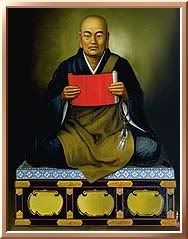
Nichiren Daishonin lived from 1222 to 1282 during a tumultuous time of social unrest and natural catastrophe. The son of a fisherman, he became a religious acolyte and after a period of intensive study he came to realize that the Lotus Sutra constitutes the heart of Buddhist teachings.
He also brought it out of the realm of theoretical contemplation into an actual experiential practice when he first chanted Nam-myoho-renge-kyo (Devotion to the Mystic Law) on April 28, 1253, and later inscribed the Gohonzon (the physical object of devotion for all humanity).
He subsequently dedicated his life to sharing his realization, despite facing numerous persecutions for preaching what was considered a subversive doctrine. By declaring that embracing this law had the power to allow all individuals to attain enlightenment, the Daishonin disturbed the ruling class of politicians and priests who adhered to other forms of Buddhism. Nonetheless, he gained a loyal following of believers. He especially embraced ordinary people from all walks of life.

After Nichiren Daishonin's passing, his closest disciple, Nikko, kept the true spirit of Buddhism alive. For the next six centuries, the Daishonin's Buddhism was maintained by a relatively small religious group until the early part of the twentieth century.

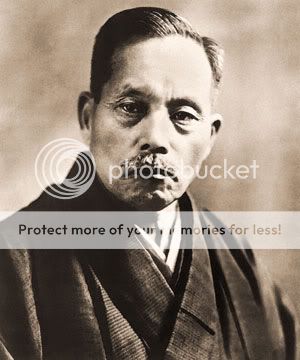
Tsunesaburo Makiguchi (1871--1944), an educator in Japan, was passionately dedicated to the reform of the Japanese educational system, which emphasized rote learning over critical independent thinking. He strove to develop modes of education that would unleash the potential of the individual. After studying Nichiren Daishonin's teachings, he realized that they could provide the philosophical underpinnings for the value-creating education that had been his lifetime goal.

In 1928, Mr. Makiguchi committed himself to practicing this Buddhism along with a young teacher, Josei Toda (1900s58), whom he had met in 1920. In 1930, they founded the Soka Kyoiku Gakkai, or "Value Creation Education Society," as a laypersons' organization, drawing its membership principally from among fellow educators.

Japan was then plunging headlong into war, a course diametrically opposed to the Buddhist reverence for life. As World War II progressed, the militarist government redoubled its efforts to crack down on all forms of dissidence. Mr. Makiguchi and Mr. Toda found themselves under increasing pressure to compromise their beliefs and practice the state religion of Shintoism.

Finally, the government asked the high priest of Nichiren Shoshu to accept a Shinto object of worship and enshrine it at the head temple. This would be in direct contradiction with the teachings and spirit of Nichiren Daishonin. The priests, fearful of their own safety and wanting to curry favor with the authorities, accepted this governmental order to protect themselves from persecution.
Mr. Makiguchi, however, refused to violate the spirit of the Daishonin's Buddhism. His resistance to the government order led to his and Mr. Toda's arrest and imprisonment as "thought criminals" in 1943 along with other Soka Kyoiku Gakkai leaders. Mr. Makiguchi, at 72, endured brutality and privation in prison, refusing on all counts to compromise his convictions. The records of his interrogations reveal a man propounding, without a trace of hesitation or fear, the very thoughts that had led to his incarceration. On November 18, 1944, he died at 73 in the Tokyo Detention House.

Josei Toda survived the ordeal and was released on July 3, 1945, just weeks before Japan's surrender. The Soka Kyoiku Gakkai had all but disintegrated under wartime persecution. Though physically ravaged by two years in prison, he immediately set about rebuilding the organization. It was renamed the Soka Gakkai (Value Creation Society).Mr. Toda resolved that the mission of this new organization should not be confined to the field of education but rather that it be expanded to the betterment of society as a whole. The Soka Gakkai rapidly grew under Josei Toda's leadership to more than 750,000 households by the time of his death in 1958.

His responsibilities were assumed by Daisaku Ikeda, who became the third president on May 3, 1960. Mr. Ikeda had met Mr. Toda at age 19 and committed himself to practicing the ideals of the Soka Gakkai, making Mr. Toda his mentor.

Mr. Ikeda has dedicated himself continually to fulfilling the visions Mr. Toda shared with him in the areas of peace, culture and education, based on the Daishonin's teachings. Through his international travels beginning in 1960, Mr. Ikeda has contributed greatly to Buddhism becoming a truly global religion. In 1975, the Soka Gakkai International was formed, and today, Nichiren Daishonin's Buddhism is being practiced by more than 12 million people in 128 countries under the auspices of the SGI.
The American organization was formed in 1960 when Mr. Ikeda visited the United States. At the time, there were just a handful of people practicing this Buddhism in the United States. They were primarily Japanese women who had married Americans, as well as some students from Japan. But with Mr. Ikeda's encouragement, they soon grew into a nationwide organization now called SGI-USA.

The SGI believes that the development of peace, culture and education are essential to building a better world. Centered on this ideal, the SGI carries out activities globally. In 1957, Josei Toda issued a declaration against the use of nuclear weapons, labeling them criminal under any circumstances; and he called upon youth of the world to work to abolish these weapons of mass destruction.
Taking up this challenge, the SGI, under Mr. Ikeda's leadership, has been working tirelessly to create the conditions for a peaceful world. The efforts to fulfill Mr. Toda's vision of peace have resulted in the SGI's wide-ranging activities, for instance, as a nongovernmental organization with official ties to the United Nations. The SGI has sponsored public information programs that aim through exhibitions, symposia and other forums to promote awareness of the issues of war and peace and the feasibility of peaceful alternatives. Major international exhibitions on such themes as disarmament, human rights and environmental protection have traveled throughout the world bringing public awareness of these critical issues.

Personally, Mr. Ikeda has engaged in dialogues with international academics and intellectuals like British historian Arnold Toynbee and with policy-makers and political leaders such as Zhou Enlai, Corazon Aquino, Mikhail Gorbachev and Nelson Mandela, exchanging ideas on how to create world peace and better understandings among people, and many other topics. He has received numerous awards and recognition from universities and nations around the world for his efforts to promote peace.
Applying the spirit of Buddhism to modern times, he has also founded several institutions dedicated to peace and intercultural dialogue. The Toda Institute for Global Peace and Policy Research conducts independent research and networks with peace researchers, activists and policy-makers to provide a global forum for the discussion and implementation of cooperatively designed policy strategies. And the Boston Research Center for the 21st Century provides a venue for pooling wisdom and fostering dialogue among the world's peace-oriented cultural, philosophical and religious traditions, thus developing a network of global citizens in the pursuit of peace.

In 1963, Mr. Ikeda founded the Min-On Concert Association, which has sponsored tours of performing groups from some seventy countries in order to promote understanding among diverse peoples through music, dance and other cultural expressions. He also founded the Tokyo Fuji Art Museum in 1983, which is engaged in a wide-reaching program of exchange with cultural institutions throughout the world.
Education has been of central concern to the Soka Gakkai since its inception, and many ideas set forth by Mr. Makiguchi and Mr. Toda have been brought to fruition through the Soka School System. From preschool to post-graduate, the Soka system undertakes education designed to stimulate wisdom and engagement within society. On May 3, 2001, Soka University of America will open as a full-fledged liberal arts college in Southern California.
At the heart of this global movement are discussion meetings. These neighborhood gatherings where people share experiences, encourage one another and study Buddhism together are the backbone of the SGI. They are forums where anyone can speak freely, ask questions, or simply sit and watch. Meetings are held regularly in homes or in community centers. The activities are free and anyone is welcome to attend and participate. Nichiren Daishonin's Buddhism is truly a religion that crosses all boundaries, with a diversity rarely seen in other institutions. This is proof that by overcoming our impasses, by winning over our own lack of understanding and constantly striving to awaken the Buddha nature inside each of us, we can build a lasting world peace.

There is no way to legislate, dictate or force peace onto humanity. As Daisaku Ikeda writes in the foreword to his book The Human Revolution: "A great revolution of character in an individual will help achieve a change in the destiny of a nation and further, will cause a change in the destiny of all humankind."
In our jigsaw-puzzle world, then, it soon becomes obvious that through each person becoming a winner and helping others to do the same, society will change.
This is Buddhism's blueprint for world peace or "Kosen-Rufu." The only way for people to live together in peace is for many individuals to awaken to the need for an inner revolution. For one happy person's influence on his or her environment will have a profound and lasting effect.

VogueGal ベラ Copyright © 2012 Design by Antonia Sundrani Vinte e poucos